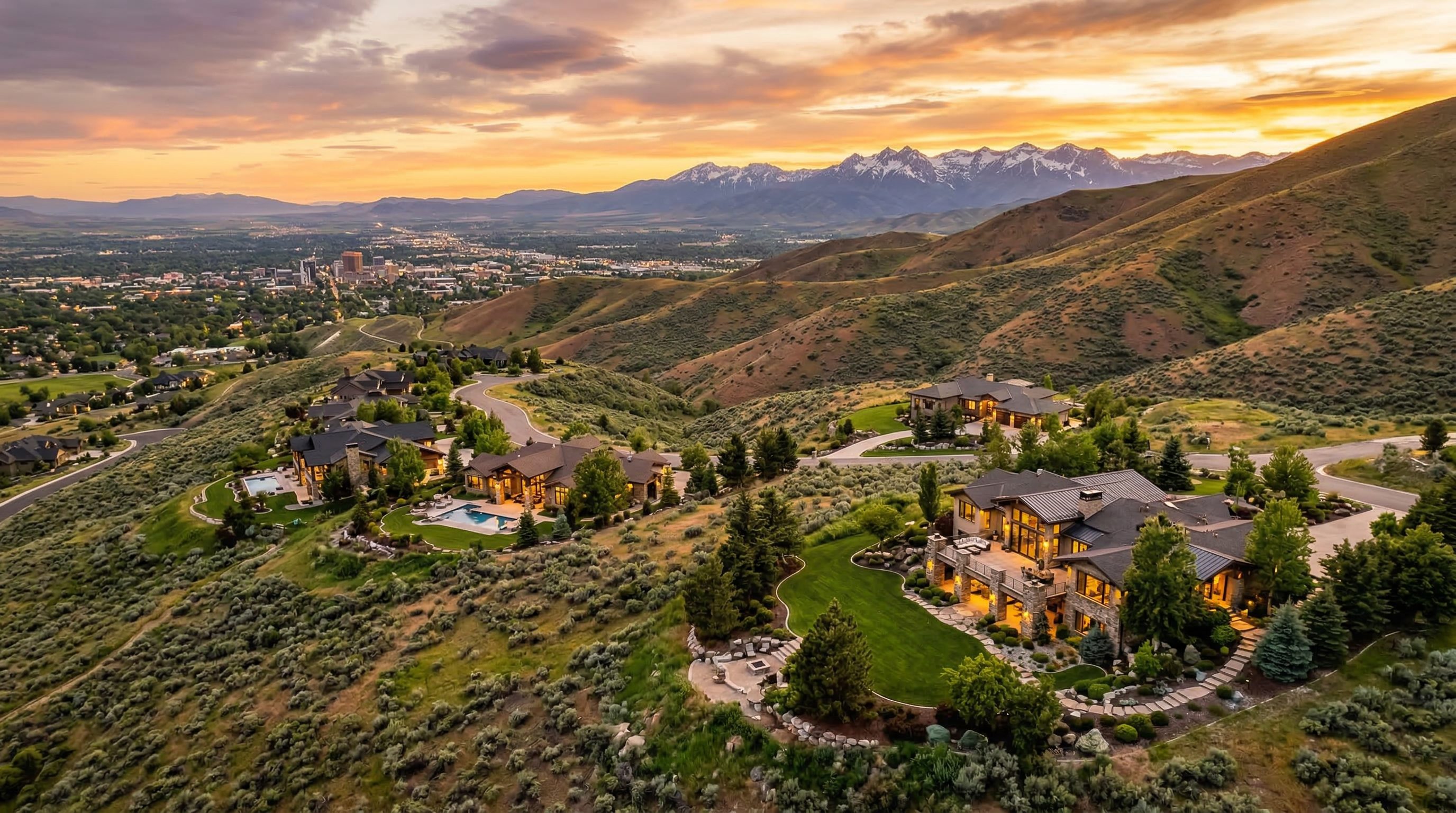
If you've been watching Boise and Eagle on your radar, you're not alone — and you're not wrong. The Treasure Valley keeps drawing buyers from across the country, and for good reason. Year-round outdoor access, a genuinely livable downtown, top-rated schools, and home values that still make sense compared to coastal markets. People arrive expecting to fall in love with the scenery and end up staying because of the community.
But "Boise" isn't one neighborhood — it's a collection of very distinct places, each with its own personality, price point, and lifestyle. I've helped buyers find their way into most of them, and I can tell you firsthand that choosing the right neighborhood matters as much as choosing the right house. So let's walk through the six areas I'm recommending most in 2026, what makes each one special, and who tends to thrive there.
1. The Highlands — Boise's Premier Luxury Enclave
If you want to understand why Boise keeps showing up on "best places to live" lists, drive up into the Highlands on a clear evening. The views over the city and toward the Owyhees are the kind that stop conversations mid-sentence. This is Boise's most prestigious address — a neighborhood of custom estates, contemporary architecture, and the kind of privacy that's genuinely hard to find this close to a vibrant downtown.
The Highlands draws buyers who want space and seclusion without sacrificing convenience. You're 15 minutes from downtown Boise, close to Bogus Basin for skiing, and surrounded by miles of foothills trail access. The homes here tend to be newer construction with high-end finishes — think open floor plans, chef's kitchens, and primary suites that feel like private retreats. This is where move-up buyers land when they're ready to stop compromising.
The lifestyle is quiet and neighborhood-oriented, with a real sense of community among residents who chose this area deliberately. If a peaceful foothills setting with strong long-term appreciation is your goal, the Highlands consistently delivers.
Market Snapshot (Spring 2026): Average home value ~$946K | Median list price ~$1.19M | 5.4% YoY appreciation — one of the strongest growth rates in the city.
Explore the Highlands in detail →
2. North End — Historic Charm with a Walkable Soul
Ask longtime Boiseans where they'd live if money were no object, and many of them will say the North End without hesitating. It's Boise's most beloved historic neighborhood — tree-lined streets, craftsman bungalows, Tudor cottages, and the kind of block-party culture that feels like it belongs in a movie. Hyde Park sits right in the heart of it: a walkable commercial strip with coffee shops, wine bars, and local restaurants where you'll run into your neighbors every single time.
The North End attracts a genuine mix of buyers — young professionals, established families, empty-nesters downsizing from bigger homes, and longtime locals who've lived there for decades and have no intention of leaving. What holds it all together is a shared appreciation for the neighborhood's character and a community that actively protects it. Historic preservation is taken seriously here, which means the streetscape stays beautiful and property values stay supported.
From a lifestyle standpoint, if you want to bike to coffee, walk to dinner, and feel connected to your neighborhood in the way most American suburbs don't allow, the North End is genuinely hard to beat. It's also one of the most competitive submarkets in the city — homes move quickly when they're priced right.
Market Snapshot (Spring 2026): Average home value ~$700K | 1–3% YoY appreciation | High demand, low inventory — homes in top condition sell fast.
Explore the North End in detail →
3. Eagle — The Treasure Valley's Family Favorite
Eagle has a reputation as a bedroom community, and technically that's fair — but it undersells what the city has actually become. Over the past decade, Eagle has developed a genuinely thriving downtown core, an outstanding school district that families move here specifically to access, and a quality of life that's hard to replicate. The pace is a little slower, the lots are a little larger, and the sense of community is as strong as anywhere I work.
What I see drawing buyers to Eagle in 2026 is a combination of space and value relative to Boise proper. You get newer construction, master-planned communities with amenities, and access to excellent parks and recreation — including Guerber Park and the Boise River Greenbelt system. Eagle is also home to some of the Treasure Valley's best-regarded elementary and middle schools, which is a major factor for families with kids in tow.
The commute into Boise is manageable if you're strategic about timing, and the tradeoff is almost always worth it for buyers who prioritize school quality, new construction options, and a strong sense of suburban community. Eagle consistently ranks among Idaho's safest cities, and that stability shows up in buyer demand year after year.
Market Snapshot (Spring 2026): Average home value ~$781K | Median sale price ~$790K (Redfin) | 59 days on market | 0.4% YoY — stable pricing with moderate buyer competition.
4. Boise Foothills — For the Outdoor-First Buyer
If your idea of a perfect Saturday starts with a trail run or a mountain bike ride before breakfast, the Boise Foothills neighborhood should be at the top of your list. This area sits along the lower slopes of the foothills north of the city, with direct access to the Ridge to Rivers trail system — over 190 miles of hiking and biking trails that begin, quite literally, at the end of many residents' driveways. There is no better trail access in the Treasure Valley.
The Foothills attract a particular kind of buyer: active, outdoorsy, and willing to trade the walkability of the North End for the raw natural access they get here. Homes range from mid-century ranches to contemporary custom builds, and many sit on generous lots with views that remind you why people moved to Idaho in the first place. It's a neighborhood where garage spaces often house more bikes than cars, and where neighbors wave to each other on trails as often as sidewalks.
Growth has been consistent here, and with limited buildable land remaining along the foothills edge, scarcity is increasingly working in favor of existing homeowners. Buyers who get in now are securing something that can't simply be replicated further out.
Market Snapshot (Spring 2026): Median sale price $733–768K | 3.9–11.3% YoY appreciation — one of the widest growth ranges in the metro, reflecting high variability by street and position.
Explore the Boise Foothills in detail →
5. East End — Quiet Elegance Near Downtown
The East End is one of Boise's best-kept open secrets — and I say that as someone who's watched it quietly appreciate for years while other neighborhoods got more attention. Situated between downtown and the Boise River, this neighborhood offers a rare combination: you're genuinely close to everything Boise has to offer — the downtown core, Julia Davis Park, the Boise River Greenbelt — yet the streets are calm, the lots are comfortable, and the architectural character is beautiful.
Homes in the East End range from charming older colonials and Tudor-style residences to tastefully updated mid-century properties and the occasional new infill build. It's a neighborhood that rewards buyers who appreciate quality over flash — you won't find massive estate compounds here, but you will find well-maintained homes on tree-lined streets where pride of ownership is obvious the moment you turn the corner.
East End buyers tend to be professionals and established couples who want proximity to downtown without the congestion, or families who prioritize Boise's best parks and the Greenbelt trail system. It's a neighborhood with a genuine sense of permanence — the kind of place people move into and stay for decades.
Market Snapshot (Spring 2026): Average home value ~$736K | Median list price ~$769K | 3.1% YoY appreciation — steady, reliable growth in a perennially desirable location.
Explore the East End in detail →
6. Boise Heights — The City's Pinnacle Address
Boise Heights holds a distinction that matters to a specific kind of buyer: it's Idaho's most expensive neighborhood by average home value. That's not a warning — it's context for what you're getting. Perched above the city on the upper foothills, Boise Heights offers something no other area in the Treasure Valley can match: sweeping, unobstructed panoramic views that take in the city skyline, the Owyhee Mountains, and — on clear days — peaks far beyond. You don't just live above Boise; you feel like you own it.
The homes here are almost exclusively custom, and the level of finish reflects that. Architecture tends toward the contemporary and the dramatic — walls of glass to capture views, indoor-outdoor living designed around the scenery, and amenities that would feel at home in Scottsdale or Park City. Many of my buyers in this price range have looked in those markets before arriving in Boise and are genuinely surprised at what their budget can achieve here.
This is also a neighborhood with exceptional appreciation, which speaks to both scarcity and sustained demand from high-net-worth buyers relocating to Idaho. If you're looking for a trophy property in a market that continues to attract wealth migration, Boise Heights is the conversation to have.
Market Snapshot (Spring 2026): Average home value ~$1.34M | Median list price ~$1.39M | 5.8% YoY appreciation — Idaho's most expensive neighborhood, with strong sustained growth.
Explore Boise Heights in detail →
So How Do You Actually Choose?
I get this question constantly, and I love it — because the honest answer is that the right neighborhood depends almost entirely on your priorities, not the rankings. Here's how I walk my clients through it:
- Lead with lifestyle, not listing price. If you hate driving and love walking to coffee, the North End is worth a stretch. If trail access is non-negotiable, the Foothills should anchor your search. The home you can afford in the wrong neighborhood will never feel like the right one.
- Know your commute tolerance. Eagle is wonderful, but if you're working downtown five days a week and hate traffic, the time cost adds up. Be honest with yourself about this before you fall in love with a house.
- Understand the market dynamics. The Highlands and Boise Heights are appreciating faster and have higher floors. North End homes sell quickly in good condition. Eagle inventory tends to run a little deeper. Your strategy should match the market you're entering.
- Think long-term, not just right now. Schools matter even if you don't have kids yet. Walkability scores matter when you're 65 and don't want to drive everywhere. Buy for the life you're building, not just the one you're in today.
- Work with someone who knows the streets. I've walked all of these neighborhoods personally. I know which blocks have the best morning light, which ones get wind off the foothills, and where the hidden value is hiding. That kind of local knowledge is genuinely hard to replace.
The Boise and Eagle markets in 2026 are competitive — buyer demand is surging, inventory is still tight, and with mortgage rates in the 6.5–7% range, well-priced homes in desirable areas don't sit long. If you're serious about buying, getting clear on your neighborhood priorities before you start touring is one of the best things you can do for your own sanity.
I'm happy to help you figure that out. Whether you want to talk through options, schedule a neighborhood tour, or just get a realistic picture of what your budget can achieve in each of these areas, I'm here for it.
Not sure which neighborhood fits your life?
Take my Home Match Quiz to get a personalized neighborhood recommendation — or find out what your current home is worth in today's market.